
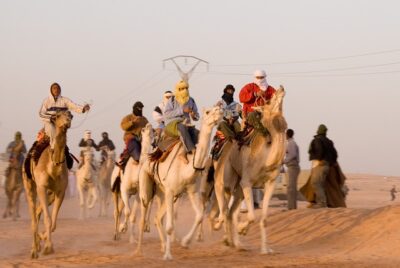
Robot Jockeys & Camel Racing in the Arab World
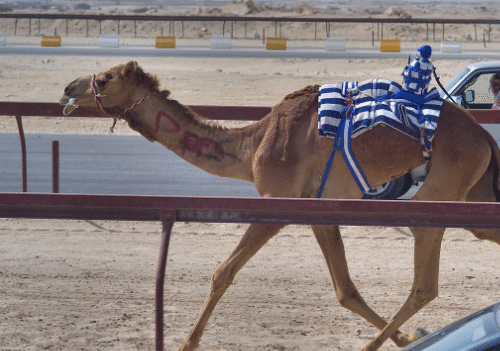
Robot jockeys have transformed camel racing across the Arabian Gulf. Today, modern camel races in countries such as the United Arab Emirates and Qatar combine one of the region’s oldest sporting traditions with remote-control technology. Instead of a human rider sitting on the camel, a small and lightweight robot jockey is attached to the racing saddle and controlled remotely by the camel’s trainer or owner.
Camel racing has a long history in the Arabian Peninsula and remains an important part of Gulf culture. What was once a traditional competition between camel owners has developed into an organized modern sport involving specialized racing camels, professional training, major racing venues and increasingly sophisticated technology.
Raqbi.com explores this fascinating combination of tradition and innovation. From the history of camel racing and the introduction of the first robotic riders to today’s technologically advanced racing equipment, our aim is to provide useful information about robot jockey camel racing and the culture surrounding this distinctive Arabian sport.
What Is a Robot Jockey?
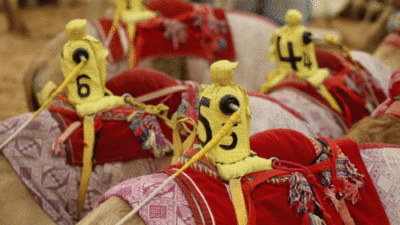
A robot jockey is a small remotely controlled device designed to replace a human jockey during a camel race. The robot is positioned on a specially designed saddle and kept as lightweight as possible so that it does not unnecessarily slow down the racing camel.
Modern versions can include remote-control systems, speakers, communication equipment and mechanisms that allow trainers to encourage the camel during a race. The exact design varies between manufacturers and racing teams, and the technology has continued to develop since robotic jockeys first became established in Gulf camel racing.
The operator does not normally sit in the stadium controlling the robot like a remote-controlled toy. During many races, trainers and owners travel alongside the track in vehicles while communicating with and encouraging their camels remotely.
This unusual combination of animal, human strategy and technology is one of the reasons why robot jockey camel racing has attracted international attention.
Why Robot Jockeys Changed Camel Racing
The introduction of robotic jockeys represents one of the most important changes in the modern history of camel racing.
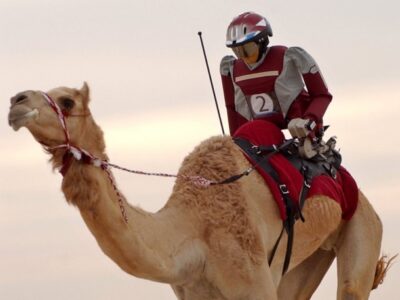
Historically, the low weight of a jockey was considered a major competitive advantage. This resulted in children being used as jockeys in parts of the Gulf region, creating serious concerns about their safety and welfare. International attention and changes in regulation eventually accelerated the search for an alternative.
Technology provided the solution.
During the early 2000s, experiments with lightweight robotic riders demonstrated that a camel could race without carrying a human jockey. As the technology improved, robot jockeys increasingly replaced human riders and became a defining feature of modern professional camel racing in several Gulf countries.
The development is an interesting example of technology being used not to eliminate a traditional sport, but to allow that tradition to continue in a different form.
How Robot Jockey Camel Racing Works
Watching a modern camel race can initially be surprising for visitors. The camels race around the track, but there are no human jockeys sitting on their backs.
Instead, each camel carries a compact robotic device.
Depending on its design, a camel racing robot can contain a radio receiver, lightweight mechanical components and a small speaker. Trainers can use remote controls to operate certain functions while communicating with their animals during the race.
Alongside many camel tracks is a separate road. Owners and trainers frequently drive alongside the racing camels, following the competition from vehicles while operating the equipment remotely.
This creates a remarkable scene: camels racing at speed on the track while a convoy of vehicles follows alongside them.
The robot itself is only one part of the system. Training, breeding, nutrition, veterinary care and the experience of the trainer continue to play important roles in competitive camel racing.
Modern Camel Racing Robots
The earliest robotic jockeys were considerably simpler than many of the devices used today. Over time, manufacturers and racing teams have worked to make the equipment smaller, lighter and easier to control.
Weight is particularly important. Every additional kilogram carried by a racing camel can potentially influence its performance, which creates an incentive to develop increasingly compact equipment.
Modern robot camel jockeys therefore demonstrate an interesting engineering challenge: the device must be lightweight while remaining reliable enough to operate during a fast and demanding race.
The technology also illustrates a broader development taking place throughout the Gulf. Traditional activities do not necessarily disappear as societies modernize. Instead, new technology can become part of traditions that have existed for generations.
Camel Racing in the United Arab Emirates
The United Arab Emirates is one of the countries most closely associated with modern camel racing. Dedicated racing tracks and training facilities can be found in different parts of the country, and important racing events attract camel owners, breeders and spectators.
For visitors unfamiliar with Gulf culture, camel racing offers an opportunity to see a side of the UAE that is very different from the skyscrapers, shopping centres and luxury hotels for which cities such as Dubai and Abu Dhabi are internationally famous.
Modern racing also shows how quickly an ancient activity can adapt. The sight of a camel carrying a small robotic rider is now characteristic of many races in the region.
Our guide to camel jockey robots in Dubai looks more closely at the connection between modern technology and camel racing in the Emirates.
Camel Racing in Qatar and the Arabian Gulf
Camel racing is not limited to the UAE. It has deep cultural roots throughout parts of the Arabian Peninsula and remains particularly significant in countries such as Qatar.
Modern racing facilities have transformed the sport from informal desert competitions into highly organized events. Racing seasons can include numerous competitions involving specially bred camels of different ages and categories.
Similar traditions can also be found elsewhere in the Gulf and Arabian Peninsula, although racing practices, events and regulations vary between countries.
Despite these differences, the robot jockey has become one of the most recognizable symbols of contemporary Gulf camel racing.
Why Racing Camels Can Be So Valuable
Competitive camel racing is much more than simply placing a camel on a track and seeing how fast it can run.
Successful racing animals can be the result of careful breeding, professional training and considerable investment. Bloodlines, physical characteristics, endurance, speed and previous racing performance can all influence the perceived value of a camel.
Owners may devote substantial resources to training facilities, specialist staff, nutrition and veterinary care. At the highest levels of the sport, camel racing can therefore involve significant financial investment.
This helps explain why the sport has historically been associated with prominent families, wealthy camel owners and prestigious racing stables in the Gulf.
Camel Racing – A Traditional Sport of the Arabian Peninsula
Long before modern racetracks existed, camels played an essential role in life across the Arabian Peninsula. They provided transportation and were closely connected with trade, travel and survival in desert environments.
Competitions between camels gradually became part of celebrations and social gatherings. Over generations, these competitions developed into the organized sporting tradition seen today.
This history is why describing camel racing simply as entertainment misses an important part of its significance. The sport also represents cultural heritage and the continuing relationship between Gulf societies and an animal that played an extraordinary role in the history of the region.
Our article about camel racing and its association with sheikhs examines this cultural and historical connection in more detail.
Robot Jockeys: Where Tradition Meets Technology
The development of camel jockey robots demonstrates that technological progress does not always have to replace tradition.
In this case, technology became part of the tradition itself.
The camel remains the athlete. Breeders still select promising animals, trainers still prepare them for competition, and owners still follow races with enormous enthusiasm. What changed was the person sitting on the camel.
Replacing human riders with lightweight robotic devices allowed camel racing to evolve while preserving many of the characteristics that have made the sport culturally significant for generations.
The Future of Robot Jockey Camel Racing
Robot jockey technology is likely to continue developing alongside advances in lightweight electronics, wireless communication, sensors and data analysis.
Technology is already becoming increasingly important throughout professional sport, and camel racing is no exception. Training data, veterinary science and performance analysis may become just as significant as improvements to the robotic jockey itself.
Yet the fundamental attraction of camel racing remains remarkably traditional: breeding a strong racing camel, preparing it for competition and watching it compete against the best animals from other stables.
That combination makes modern camel racing unusual. It is simultaneously ancient and technological, local and international, traditional and innovative.
Discover Camel Racing with Raqbi
Raqbi.com is an independent information website dedicated to camel racing, robot jockeys and the technology and culture surrounding this remarkable sport.
Our articles explore the history of camel racing, the development of robotic jockeys, racing traditions in the Arabian Gulf and the continuing evolution of modern camel racing.
Whether you discovered robot jockeys for the first time, are researching camel racing in the UAE or Qatar, or simply want to understand why robots now ride some of the world’s fastest racing camels, Raqbi provides a starting point for discovering a fascinating meeting of Arabian heritage and modern technology.
Raqbi.com provides independent informational and editorial content. Information may change over time, and readers should consult official organizers or relevant authorities for current information about individual races, venues and regulations.
